
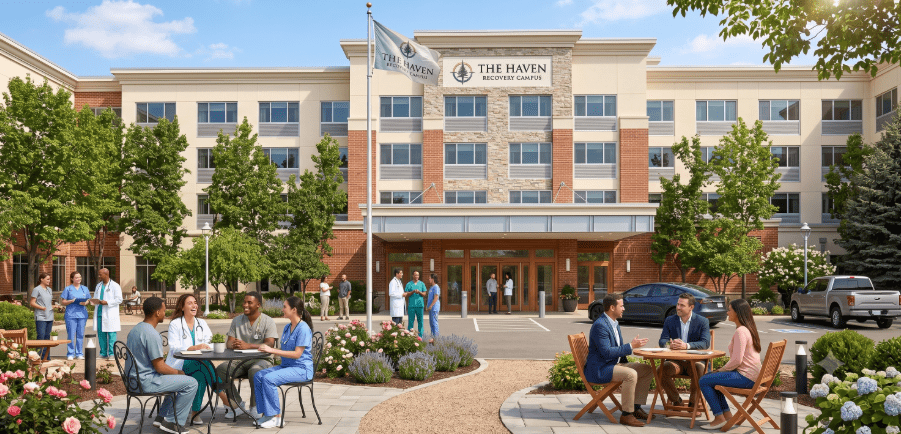
At 2901 Chicago Avenue in the Phillips neighborhood of Minneapolis, there is a four-story former luxury hotel sitting largely vacant. It has been sitting largely vacant since June 2020. The building was built in 2005. It has 136 former hotel rooms across four floors, a 71-space surface parking lot, 1.65 acres of land, and a location directly adjacent to Abbott Northwestern Hospital and Midtown Global Market — two of the most significant institutional anchors in South Minneapolis.
The owner has invested approximately four million dollars in restoration work since 2020. The Minneapolis Planning Commission approved a conditional use permit in July 2025 for conversion of the building to a 182-bed state credentialed care facility. The approved operator has not performed.
The permit expires unrecorded in approximately August 2027.
That is the opportunity. It is one of the most significant undeveloped recovery housing assets in Minnesota. It is sitting in plain sight. And the reason nobody has built it yet is not the building, not the location, not the neighborhood, and not the regulatory environment. The reason nobody has built it yet is that building a legitimate, fully compliant, financially viable recovery campus requires a specific combination of property management expertise, compliance infrastructure, technology platform, financing strategy, and political navigation that almost nobody in the Minnesota recovery housing space has assembled in one place.
Digital Matrix Group assembled it. Here is what that looks like.
What the building actually is
The former Sheraton Midtown was purpose-built as a short-term residential facility. Hotel rooms are private and semi-private sleeping rooms with individual bathrooms. The building has two stairwells, an elevator, a lobby with separate commercial street frontage on both Chicago Avenue and East Lake Street, a kitchen, laundry infrastructure on residential floors, and housekeeping stations. It was designed for transient short-term occupancy with 24-hour staffing.
That physical profile maps almost perfectly to what a 254B-certified recovery residence requires. Private and semi-private sleeping rooms. Common areas. Laundry. 24-hour staffed operation. Street-level commercial activation on a Goods and Services Corridor. The building does not need to be reimagined for recovery housing. It needs to be operated for recovery housing.
The floor plans submitted with the July 2025 conditional use permit application show 84 beds on the second floor, 49 beds on the third floor, and 49 beds on the fourth floor. The first floor was designed with group therapy rooms, medical office space, administrative offices, and a coffee shop. Total proposed bed count was 182.
The concept Digital Matrix Group developed does not pursue 182 beds under a single operator under a single license. It structures the building as a multi-license recovery campus — three discrete 254B-certified recovery residences on floors two through four, each operating as a separately certified unit with its own management structure and resident record system, with a first-floor community services hub housing co-located employment services, peer recovery support, a licensed clinical partner, and the coffee shop that activates the street level.
That structure matters for reasons that go well beyond design preference.
Why the multi-license model is the right model
The 254B certification framework was written for community-scale recovery residences. The statutory language — resident governance requirements, home-like environment expectations, the prohibition on co-located treatment services — was drafted with six-to-fifteen-bed sober homes in mind. Applying that framework to a 182-bed institutional facility under a single operator raises legitimate questions about whether the resulting operation satisfies the spirit of the standard, not just the letter.
The multi-license model resolves that question. Each certified floor operates as a discrete recovery residence with its own resident council, its own management staff, its own documentation trail, and its own DHS certification. The building is the physical container. The certified residences are the distinct operating units inside it.
The first-floor separation is equally important. The 254B standard explicitly prohibits co-location of treatment services within a certified recovery residence. A clinical partner — a separately licensed 245G provider — operating independent treatment services on the first floor under a lease arrangement is not co-located treatment within the certified residence. It is a separate entity providing a separate service in a separate licensed space within the same building. Residents have access to clinical services through a formal referral relationship. The 254B certification of the residential floors remains clean.
This is the architecture that allows the building to function as a full-service recovery campus while each component maintains its distinct regulatory standing.
The financing structure that makes it viable
The project is financially viable under a specific capital stack. Without that stack it is not viable. Understanding the difference is why most operators who look at this building walk away.
The all-in development cost — acquisition at approximately $3.5 million, rehabilitation at approximately $5.2 million, furniture fixtures and equipment, licensing fees, and operating reserves — comes to approximately $9.8 million in the base case. That is not a number a typical recovery residence operator can finance through conventional means.
The New Markets Tax Credit program changes that calculation materially. Made permanent under legislation signed July 4, 2025, the NMTC program provides approximately 15 to 20 percent of project cost in effective savings through below-market-rate financing with partial principal forgiveness after a seven-year compliance period. On a $9.8 million project that is approximately $1.76 million in effective subsidy before the first resident moves in.
The Phillips neighborhood census tracts surrounding 2901 Chicago Avenue are qualified low-income communities. The property likely sits in or adjacent to a designated Opportunity Zone — a one-hour verification item using the CDFI Fund mapping tool. Opportunity Zone investment, made permanent under the same July 2025 legislation, eliminates federal capital gains tax on appreciation for investors who hold a ten-year position. That dramatically reduces the return hurdle for private capital entering this deal.
Stack those two instruments together and the net effective capital requirement drops to approximately $8 million. At 85 percent occupancy across 140 certified beds — a conservative figure well below the building’s maximum capacity — the campus generates approximately $2.12 million in gross annual revenue, approximately $902,000 in annual operating expenses, and approximately $1.22 million in net operating income. That is a 15.2 percent cap rate on cost and a 57 percent NOI margin.
The operating break-even is 47 percent occupancy — 66 of 140 beds. The campus covers its fixed costs at less than half capacity. It does not require near-full occupancy to remain solvent during the ramp period. That is an unusually low-risk operating profile for a real estate development of this scale.
At a stabilized market cap rate of 7.5 percent — the blended rate for behavioral health and community facility assets in Minneapolis — the campus is worth approximately $16.2 million on the income-producing real estate market. Against a net effective development cost of $8 million, that implies approximately $8.2 million in value creation. A 103 percent return on net invested capital before accounting for five years of annual cash flow during the hold period.
The revenue is anchored by the Minnesota Housing Support Program room and board rate — currently $1,192 per month per resident in a group setting, effective July 1, 2025. HSP income is government-set and government-backed. It behaves more like a Section 8 voucher stream than a market rent — predictable, recession-resistant, and not dependent on the operator finding private-pay clients to fill beds.
What the political environment makes possible
This project does not need political support to proceed. It needs political support to move at the speed the CUP expiration timeline requires.
The DHS Recovery Residence Work Group is meeting monthly throughout 2026 and will deliver recommendations before year end on funding models, certification delegation, and the transition from FSRB to the HSP direct agreement structure. A recovery campus of this scale — demonstrating what the 254B framework produces when a credible, compliant operator takes it seriously — is exactly what that work group needs to point to in its final report.
Representative Michael Howard, who chairs the House Housing Finance and Policy Committee and was the lead author of the emergency supportive housing bill signed in March 2026, has direct interest in seeing the $141 million in projected FY2027 savings from the recovery residence standards implementation actually materialize. A campus that validates the framework delivers that proof of concept in his committee’s jurisdiction.
Ward 9 Council Member Jason Chavez and Ward 6 Council Member Jamal Osman both represent constituents who have watched this building sit empty for five years. A credible operator with a community integration model — employment services, peer recovery support, first-floor commercial activation on Chicago Avenue — is not a neighborhood liability. It is a neighborhood asset. That is a different political conversation than the one Sobriety Inc. would have had.
Allina Health and Abbott Northwestern Hospital are the neighborhood’s dominant institutional employers. Abbott Northwestern regularly discharges patients who need step-down recovery housing with no adequate proximate option. A formal referral relationship with Abbott Northwestern is simultaneously a community benefit argument and a resident pipeline. A letter of support from Allina Health changes the tenor of every grant application and every legislative conversation.
What needs to happen and in what order
The path from here to an operational campus has six steps that cost nothing but time and produce the information needed before any capital is committed.
The Opportunity Zone tract status for the 55407 ZIP code needs to be confirmed against the CDFI Fund mapping tool. One hour.
A pre-application consultation with Aaron Hanauer at Minneapolis Community Planning and Economic Development — the senior planner who wrote the July 2025 staff report and knows the building — needs to address whether converting from the approved SCCF use to a 254B multi-license model requires a new CUP or an amendment to the existing one.
A DHS pre-consultation needs to address whether the agency will certify multiple discrete Level Two recovery residences within a single building under a single ownership entity. This question has a specific answer. Getting that answer before acquisition is required.
An approach to the building owner through his legal counsel at Larkin Hoffman needs to assess whether ownership is open to a conversation given the approved operator’s non-performance and the approaching CUP expiration deadline.
A NMTC Community Development Entity engagement needs to confirm program availability for a behavioral health recovery housing project in a qualified Phillips census tract.
An outreach to Allina Health community health needs to gauge interest in a referral relationship and begin the conversation that produces an institutional letter of support.
None of those six steps require a purchase commitment. All of them either confirm the project is viable and the path is open or surface a disqualifying condition early enough to redirect resources. Either outcome is useful.
Who needs to be at the table
This project requires a specific set of capabilities that do not typically exist in one organization.
It requires a licensed property manager with operational track record — someone who can sit across from Jay Patel’s attorneys at Larkin Hoffman as a credible counterparty and negotiate a purchase or management agreement on terms that reflect the building’s situation rather than its asking price.
It requires a compliance infrastructure already built to the 254B.211 standard — policy and procedure documentation, resident management technology, case management system, required forms and postings — that can be deployed into the building without a twelve-month build period that the CUP expiration timeline cannot accommodate.
It requires a financing strategy that accesses NMTC, Opportunity Zone, SAMHSA grant programs, Minnesota Housing Trust Fund capital, and CDBG first-floor improvement funds — not as theoretical options but as active conversations with the specific CDEs, program officers, and grant administrators who control those resources.
It requires a technology platform that is open source, hosted on the operator’s own AWS infrastructure, and incapable of collapsing the way Kyros collapsed — because the residents’ housing stability cannot be contingent on a SaaS company’s continued operation.
It requires a political and community relations strategy that gets Ward 9, Abbott Northwestern, and the DHS Work Group to the table as allies rather than observers.
Digital Matrix Group built the compliance infrastructure. We built the technology platform. We developed the financing strategy. We mapped the political relationships. We produced the full feasibility analysis — capital stack, pro forma, cap rate assessment, three-scenario sensitivity analysis, break-even calculation, debt service capacity — against the actual building, the actual DHS rate schedule, and the actual Minneapolis construction cost benchmarks.
We are not presenting this as a finished deal. We are presenting it as a structured opportunity that is available to a qualified operator right now, before the August 2027 CUP expiration forces the building back to square one. The full analysis — acquisition approach, rehabilitation cost estimate, operating pro forma, financing structure, regulatory roadmap, political pitch, and six-step immediate action plan — is available to qualified parties under a fully executed non-disclosure agreement.
The building is there. The CUP is there. The framework is there. The financing instruments are there. The political environment is there.
What has been missing is someone willing to do the work of assembling all of it into a structure that actually functions.
That work is done.
Reach out today to have a conversation for the turn key model Digital Matrix Group has built out.